

| S.N | Exotoxin | Endotoxin |
| 1. | It is released outside the cell. | It is present inside the cell membrane and released only when the cell lyse. |
| 2. | It is proteinous in nature. | It is lipoproteinous in nature. |
| 3 | It is heat labile generally. | It is heat stable generally. |
| 4 | It is mostly secreted by gram positive bacteria. | It is secreted by gram negative bacteria. |
| 5 | It can be converted to toxoid. | It cannot be converted to toxoid. |
| 6 | It often has enzymatic action. | It does not have enzymatic activity. |
| 7 | It is highly antigenic. | It is less antigenic. |
| 8 | It is highly toxic in minute dose. | It is moderately toxic. |
| 9 | It is filterable. | It is not so filterable. |
| 10 | It gets denatured by boiling. | It does not get denatured. |
| 11 | It is less stable. | It is more stable. |
| 12 | It has high degree of specificity. | It has low degree of specificity. |
| 13 | Its molecular weight ranges from 50-1000 kDa | Its molecular weight is 10 kDa. |
| 14 | Chromosomal genes contain synthesis. | Extra chromosomal genes contain synthesis. |
| 15. | Fever won’t occur in host. | Fever occurs as it is pyrogenic to host. |
| 16 | It causes botulism, gas gangrene, tetanus, cholera, plague, etc. | It causes salmonellosis, typhoid fever, endotoxic shock. |
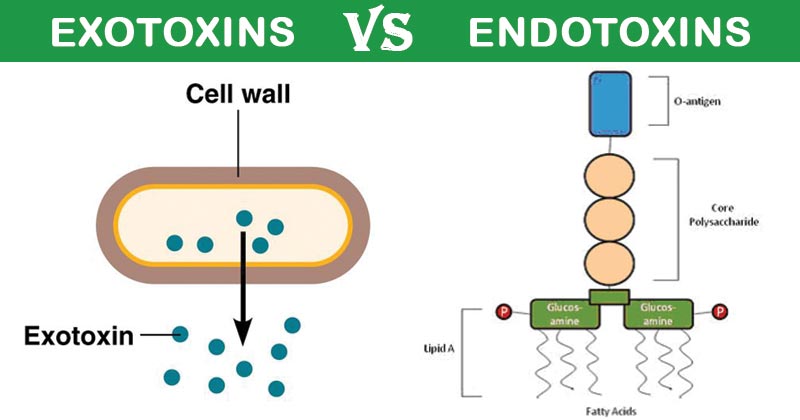
Image source: thebiologynotes
References:
i) https://microbeonline.com/basic-properties-of-exotoxins-and-endotoxins-and-their-differences/
ii) https://www.microrao.com/micronotes/exotoxin.htm