

| S.N | Mitosis | Meiosis |
| 1. | It occurs in somatic cells. | It occurs in sex cells. |
| 2. | Two daughter cells are produced. | Four daughter cells are produced. |
| 3. | Each daughter cell contains diploid chromosomes. | Each daughter cell contains haploid chromosomes. |
| 4 | No pairing or synapsis of homologous chromosome. | Pairing or synapsis of homologous chromosomes occurs. |
| 5. | No chiasma formation or crossing over. | Chiasma forms and crossing over occurs. |
| 6. | Helps in growth and differentiation. | Helps in continuity of species. |
| 7. | The whole process complete in one sequence or phase after one round of DNA replication. | The whole process completes in two successive divisions which occur one after the other. |
| 8. | The prophase is of short duration. | The prophase is of long duration. |
| 9 | Prophase has no any sub stages. | Prophase has six sub stages. |
| 10. | Duplication of chromosomes takes place in the early prophase. | Duplication or splitting of chromosomes occur in late prophase. |
| 11. | The chromosome number remains the same in the newly formed daughter cells. | Chromosome number is reduced to half in the newly formed daughter cells. |
| 12. | The exchange of genetic material between the homologous chromosomes does not occur. | The exchange of genetic materials takes place between the chromatids of homologous chromosomes. |
| 13. | Single nuclear and cellular division. | Two nuclear and cellular division. |
| 14. | Interphase always occurs between two mitosis. | No specific interphase before the second meiotic division. |
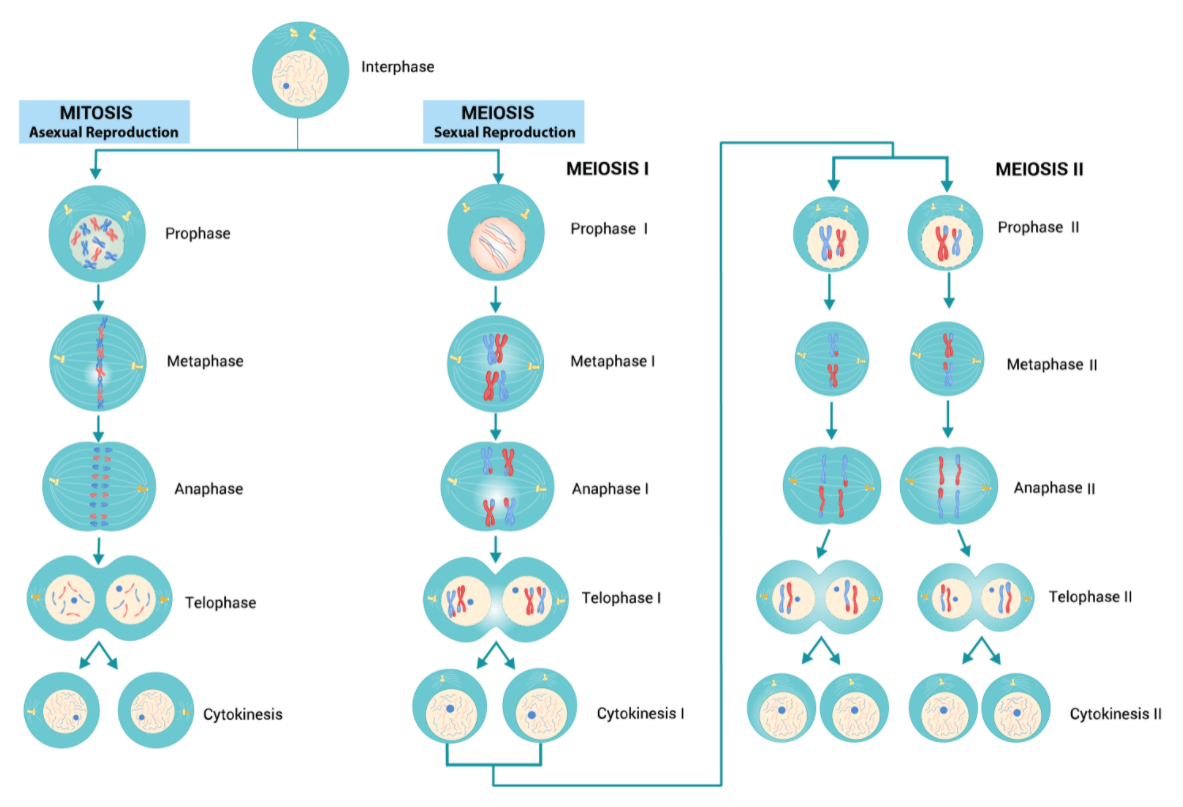
Image source: mometrix
References:
i) https://www.mometrix.com/academy/cellular-division-mitosis-and-meiosis/
ii) https://askabiologist.asu.edu/cell-division