

| S.N | Spermatogenesis | Oogenesis |
| 1. | It occurs in seminiferous tubules of testes. | It occurs in ovaries of female. |
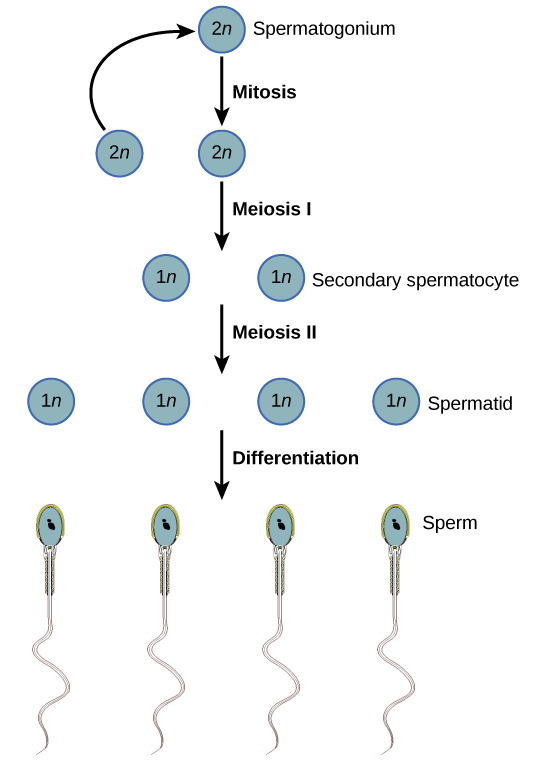
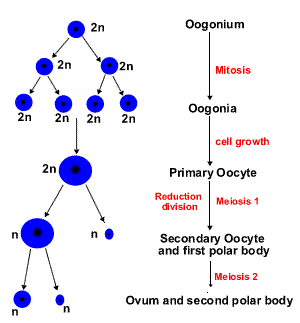
| 2. | It results in the production of four sperm cells, all of which are functional. | It results in the formation of only one large egg cell or ovum and three polar bodies. |
| 3. | Mature sperms are very small and active. | Mature eggs are very large and passive. |
| 4. | Spermatogenesis is completed in the testis. | The secondary oocyte is released from the ovary and thus formation of egg takes place outside the ovary. |
| 5. | Spermatid undergoes spermiogenesis to get transformed into a sperm. | No such stage takes place during egg formation. |
| 6. | Millions sperm produce per day. | One ovum per 28 day. |
| 7. | Occurs throughout adult life. | Ends at menopause. |
| 8. | Begins at puberty. | Begins in fetus. |
| 9. | Involved in gamete production in germ line epithelium. | Not involved in gamete production in germ line epithelium. |
| 10. | It is a continuous process. | It is not a continuous process. |
| 11. | Growth phase is short. | Growth phase is prolonged. |
| 12. | It takes 74 days to complete. | It takes days to years. |
| 13. | It forms motile male gamete. | It forms non-motile female gametes. |
| 14. | Sertoli cells are present.
|
Sertoli cells are absent
|
References:
i) https://teachmephysiology.com/reproductive-system/embryology/gametogenesis/
ii) https://pediaa.com/difference-between-spermatogenesis-and-oogenesis/