

Introduction
Epithelial tissue is one of the four basic types of animal tissues. It is a covering tissue. It forms thin sheets which cover body structures and also line the cavities of all the hollow organs of the body. It is arranged in single or multilayered sheets. It is supported and attached to underlying connective tissue by a basement membrane. A basement membrane is a continuous sheet consisting of collagen and other proteins. Cells are compactly arranged and lack intercellular space. It is not supplied with blood vessels. It gets oxygen and nutrients by diffusion from lymph vessels. It is derived from ectoderm and endoderm.
Functions of epithelial tissue
- Provides cover to most of the structures and covering in the body.
- Forms barriers that keep different body systems separate.
- Provides protection to the body organ.
- Some are concerned with the secretion of useful substances.
- Helps in excretion and absorption.
- Helps in receiving stimuli.
- Gives rise to germ cells.
Types of epithelial tissue

Image source: Pininterest
A) Simple epithelial tissue
Simple epithelial tissue consists of a single layer of cells. The cells of these tissues rest on a basement membrane. this tissue is of various types. They are as follows:
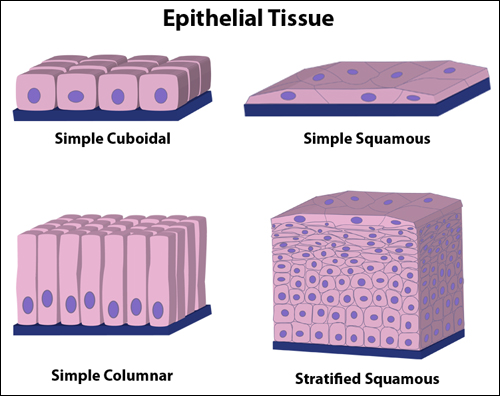
Image source: socratic
Squamous epithelial tissue
- The cells are thin, flattened, and contain little cytoplasm enclosing a centrally placed nucleus.
- The margins are irregular and cells are hexagonal or polygonal arranged like the tiles on the floor.
- It is also known as pavement epithelium.
- It forms the peritoneal lining of the coelom, buccal cavity, nasal cavity, blood vessels, bowman’s capsule of the kidney, and alveolar lining of the lungs.
- It provides protection, absorption, filtration, and exchange of gases.
Cubical(cuboidal) epithelium
- The cells are cube-shaped, having equal height and width.
- Have a central spherical nucleus.
- Form the lining of many ducts such as the salivary, pancreatic, and collecting ducts of the kidney.
- Also found in many glands such as the mucus, sweat, and thyroid glands.
- Play an active role in secretion, absorption, and excretion.
Columnar epithelium
- Cells are elongated, having a spherical nucleus at their bases.
- Are placed side by side like columns.
- Form the lining layer of the mucous membrane of the stomach, intestine, and the urinogenital organs.
- Also lines and protects many kidney ducts and is a component of the thyroid and gland bladder.
- Are mainly protective, secretory, and absorptive in function.
Pseudo-stratified epithelial tissue
- Are columnar and ciliated.
- Found in the epithelial lining of the respiratory tract, urinary tract, vas deferens, epididymis, etc.
- All cells do not reach the surface.
- Longer cells have cilia and shorter cells do not have cilia.
- Nuclei are arranged at different levels as their placement is in such a way.
- Gives it the appearance of multi-layered and stratified.
B) Compound or stratified epithelial tissues
- Are made up of several layers of cells.
- They are mainly protective in nature.
- They are of two types. They are:
Stratified epithelium
- Made up of many layers of cells.
- Different layer cells have different natures.
- The lowermost layer is a columnar epithelium resting on a basement membrane.
- Germinal in nature and produces new cells which are pushed upward.
- They are of following types:
a) Stratified squamous epithelium
- The cells of the upper layer are flattened polygonal known as squamous.
- These are of two types:
i) Keratinized stratified epithelium
- The outermost layer contains keratin (a fibrous protein).
- The keratin makes the outer layer impervious to water and the cells become dead.
- The outermost layer is called the stratum corneum (horny layer).
- These are found in hairs, claws, and nails.
ii) Non-keratinized stratified epithelium
- Layers of living squamous cells are formed by lower cuboidal cells.
- They are found on the wet surface like the buccal cavity, esophagus, and vagina.
b) Stratified cuboidal epithelium
- The cells of the outermost layer are cuboidal.
- They form the conjunctiva of the eyes, the lining of sweat glands, mammary glands, and the female urethra.
c) Stratified columnar epithelium
- The cells in the upper layer are columnar types.
- The middle layers are of cuboidal type.
- They form the lining of the vasa-differentia, respiratory tract.
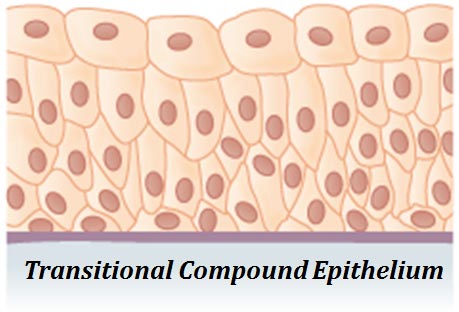
Transitional epithelium
- Made up of several layers of cells.
- They are living, large, and more stretchable than the stratified epithelium.
- Allows the expansion of the organs by changing it’s appearance.
- Found in the ureter, urinary bladder, and renal pelvis.
C) Specialized epithelial tissue
- Some epithelial tissues are specialized to perform various other functions.
- They are of the following types:

Image source: sciencedirect
Ciliated epithelium
- Cells are elongated like columnar epithelium but bear numerous cilia at their free surfaces.
- Some goblet cells are found in between the ciliated epithelial cells which secrete mucus.
- The inner surface of the respiratory passages, oviducts, ureter, spinal cord, etc. is formed of ciliated epithelial cells.
- Serve to move materials from one location to another.

Sensory epithelium
- Modified forms of columnar epithelium.
- Found in between the columnar epithelial cells.
- Cells are provided with sensory hairs (cilia) at their free surfaces, which are sensitive in nature.
- Perceive stimuli of different kinds.
- Form the lining of the tongue and nasal cavities.
Germinal epithelium
- Found in gonads.
- Form lining of the ovary and seminiferous tubules of the testis.
- Cells divide by meiosis division to form sperms in males and ova in females.
- Either cuboidal or columnar cells.

Glandular epithelium
- Modified columnar and cuboidal cells.
- Specialized in the secretion of chemical substances needed for different activities of life.
- They form glands.
- The glands secrete hormones, enzymes, saliva, and mucus.
References:
i) https://training.seer.cancer.gov/anatomy/cells_tissues_membranes/tissues/epithelial.html
iii) https://socratic.org/questions/what-are-the-three-general-cell-shapes-of-epithelial-tissue
iv) https://www.sciencedirect.com/topics/agricultural-and-biological-sciences/simple-columnar-epithelium
v) https://www.pinterest.com/pin/classification-and-types-of-epithelial-tissues-rs-science–745064332128641753/