

| S.N | Convex lens | Concave lens |
| 1. | It is thick in the middle but thin at the edges. | It is thin in the middle but thick at the edges. |
| 2. | It converges the parallel rays of light falling on it. | It diverges the parallel rays of light falling on it. |
| 3. | It has a real focus. | It has a virtual focus. |
| 4. | The image formed can be real, virtual, enlarged or diminished based upon the position of object. | The image formed is always virtual, upright and diminished. |
| 5. | It is also known as converging lens. | It is also known as diverging lens. |
| 6. | Focal length is positive. | Focal length is negative. |
| 7. | It is used to correct Hyperopia (farsightedness). | It is used to correct Myopia (nearsightedness). |
| 8. | Convex means “curved or rounded like the outside of sphere”. | Concave means “hollowed or rounded”. |
| 9. | It is used in eye, camera, overhead projector, focus sunlight, magnifying glasses, simple telescope, etc. | It is used in glasses, spy holes in door, some telescopes, back windows of some coaches, etc. |
| 10. | 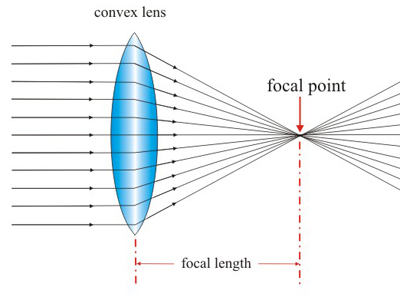 |
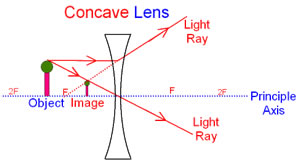 |
References:
i) https://dewwool.com/difference-between-the-concave-and-convex-lens/
ii) http://www.passmyexams.co.uk/GCSE/physics/concave-lenses-convex-lenses.html