

| S.N | Metals | Non- metals |
| 1. | Metals are solid at ordinary temperature except mercury. | Non-metals are found in all three states. |
| 2. | They possess metallic lustre except lithium. | They do not possess any metallic lustre except iodine and graphite. |
| 3. | They are generally hard except sodium and potassium. | They are generally soft except diamond. |
| 4. | They are hardly broken into pieces. | They can be broken easily. |
| 5. | Boiling point is high. | Boiling point is low. |
| 6. | Melting point is high. | Melting point is low. |
| 7. | They emit sonorous sound when struck with hammer. | They do not emit such sound. |
| 8. | They are malleable. | They are non-malleable. |
| 9. | They are generally good conductors of heat and electricity. | They are poor conductors except graphite. |
| 10. | They are ductile. | They are non-ductile. |
| 11. | Molecules are closely packed. | Molecules are not packed closely as in metals. |
| 12. | They have high specific gravity except Li, Na, K, Ca, etc. | They have low specific gravity except diamond. |
| 13. | They generally form alloys. | They do not form alloys generally. |
| 14. | They form basic oxides except few metals. | They form acidic oxides except few nonmetals. |
| 15. | Metals rarely combine with hydrogen to form unstable hydrides. | They usually combine with hydrogen to give stable hydrides. |
| 16. | Most of the metals give salt and hydrogen gas after reacting with dilute acids. | They do not form salt and hydrogen with acids. |
| 17. | They are heavy except Na, K, Mg. | They are generally light to weight. |
| 18. | They are located in s, p, d and f blocks. | They are located in s and p blocks. |
| 19. | They are found in the left side of periodic table. | They are found in the right side of periodic table. |
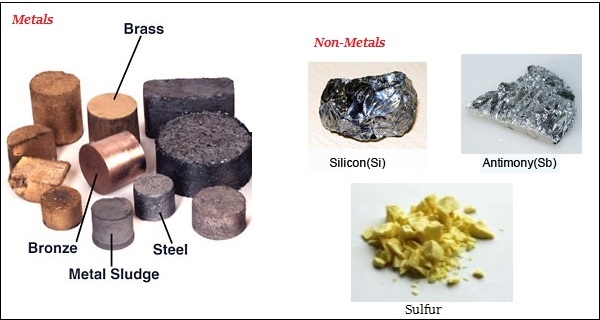
Image source: tutorialspoint
References:
i) https://tutormate.in/cbse-class-10-chemistry/difference-between-metals-and-non-metals/