
Factors Influencing the Rate of Reaction

The rate of reaction is governed by number of factors. Those having appreciable effect are described below: a) Nature of reactants Reactions involving polar and ionic substances including the proton-transfer reactions are usually very fast. On the other hand, the reactions in which bonds are rearranged, or electrons transferred, are slow. Oxidation- reduction reactions, which … Read more
Purification of Organic Compounds

The purification of organic compounds is tedious unlike inorganic compounds because large number of them decomposes on heating, some are sensitive to other reagents and resist the solvent action of water. Depending on the nature of the compound and nature of impurities present, various methods can be employed for the purification of a particular compound. … Read more

Short Sightedness and Long sightedness

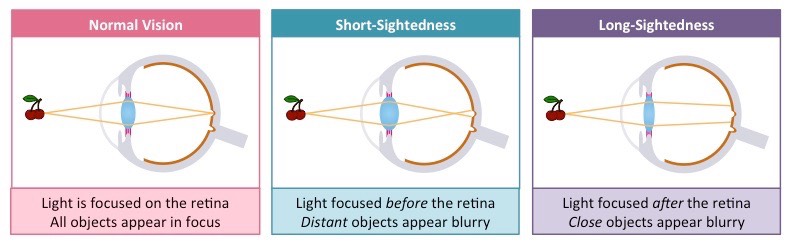
Far and near points The eye consists of a lens L and retina R where retina is light sensitive screen. Light from the objects enters the eye through the cornea. In order to be clearly seen, the image formed by the eye-lens must appear on the retina. The ciliary muscles can change the diameter of … Read more

Combined Gas Law or the Gas Equation

Combined gas law states that, for a given mass of a gas, the product of its pressure and volume divided by its Kelvin temperature is a constant. Boyle’s Law and Charle’s Law give separately the effect of pressure and temperature respectively on the volume of a gas. Combined Gas Law or the gas equation gives … Read more

Mechanical energy and It’s types

The energy possessed by a body because of its motion and position or state is called mechanical energy. For example: a moving car possesses energy; a stone lying at height from the ground possesses energy; a compressed or stretched spring possesses energy and so on. The mechanical energy is of two types. They are A) … Read more

Division of Periodic Table into Blocks

The long form of periodic table can be divided into four main blocks. These four main blocks are s, p, d and f –blocks. The division of elements into blocks is purely based upon the electronic configuration. The nature of the subshell in which the last electron of that atom enters, determines the block to … Read more

Problems of Pregnancy

The period between conception (fertilization) and birth is called pregnancy. The pregnancy period generally lasts for 9 months and 7 days. During this period, some health problems are observed. They can be in the form of minor problems and major problems both. A)Minor problems of pregnancy The various minor problems of pregnancy are: Nausea and … Read more

De Broglie theory (Duality)

The photoelectric effect showed that light consists of streams of particles called photons. This leads to the conclusion that like matter, light radiation can sometimes behave as particles. The phenomenon of interference, diffraction and polarization of the light indicate that light is wave. Light therefore, exhibits dual nature. It behaves like particle as well as … Read more

Excitation and Ionization Potential

Excitation Potential The energy required to raise an atom from its ground state to an excited state is called the excitation energy. Under normal conditions, hydrogen atoms are usually in their lowest energy state where n = 1. This is called ground state of hydrogen atoms. However, if the atoms are exposed to incident energy … Read more

Uses of Noble Gases

The main use of noble gases is due to their chemical inertness and low boiling points. Important uses of noble gases are as follows: Uses of Helium (He) It is used in inflating the tyres of big aero-planes as it is lighter than air. It is used for filling observation balloons due to its non-inflammability. … Read more